This project focuses on OER governance and policy frameworks, including the strategies, guidelines, regulations and recommendations developed to support the co-creation and use of educational artefacts in Higher Education. The project is grounded in the principles of openness, particularly those underpinning Open Science.
To understand the diversity of educational intentions on one hand and the depth of the philosophy of Open Science on the other, we rely on a book in French called Les Philosophies de l'acte éducatifs(2014), by Yves Bertrand, former Professor at TELUQ, and on Sabina Leonelli's contemporary research on the Philosophy of Open Science, 2023. These two perspectives give some depth to envisage Openness scholarship in the diversity of the UNESCO (2021) Open Science Recommendation, far beyond access rights. Throughout history, openness has been understood from multiple perspectives, including access, flexibility, equity, collaboration, agency, democratisation, social justice, transparency, freedom, responsibility or the removal of barriers (e.g. Pomerantz & Peek, 2016; Peter & Deimann, 2013).
During the most recent global health crisis, the entire education sector needed educational resources that could be shared within and across educational networks, ensure continuity of education, and serve as alternatives to face-to-face interactions (e.g. Berrada et al., 2021 ; Peters et al., 2020). Open Educational Resources (OER) appear to offer a promising way of meeting educators’ needs, supported by UNESCO. There is the OER recommendation of 2019 but also, to address AI, the Dubaï declaration of 2024 and recent briefs on Open ecosystems. Indeed, OER are used across formal, non-formal and informal education, from basic education to continuing education and lifelong learning. With GenAI, Open ecosystems can act as safeguards for Higher education institutions' role of producers, curators and users of scientific knowledge, in responsibility and independence along with the Magna Charta Universitatum that many universities worldwide have signed.
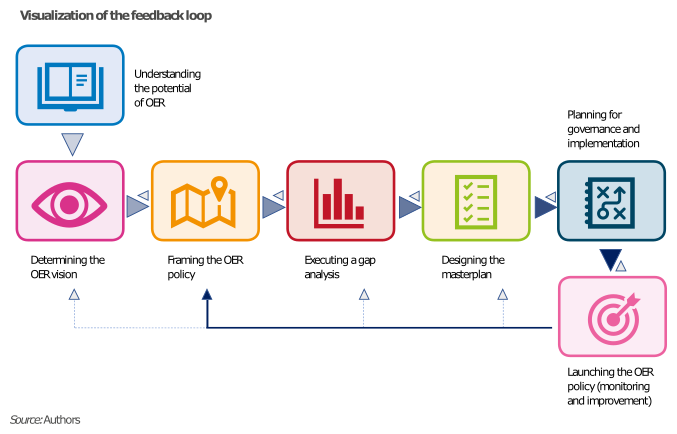
According to previous studies (e.g. Atenas et al. (2022)), developing appropriate policies at national and institutional levels has been identified as a major driver for successful adoption of Open Educational Resources (OER), Open Educational Practices (OEP) and Open Education more broadly. With this project, started in 2022 and ending in 2026, we contribute to this policy drafting endeavour with findings from two case studies led respectively in Morocco and at the University of Geneva. Indeed, such policies and frameworks have a significant impact on skills development; certification, for instance, micro-credentials; flexibility, for instance in life long learning perspectives of recognition of prior learning; access and inclusive education; the recognition and visibility of diverse forms of knowledge; institutional governance; and more generally promoting a culture of co-creation and sharing.