 Analysis of IF Differences over Time and Frequency Analysis of IF Differences over Time and Frequency
Another feature which can be used for selecting these points are the changes which occur in IF across frequency, i.e. as the CF of the filter gets closer to an area of maximal AM the IF spike becomes larger (see previous sections). These features can be seen on Figure 1 below showing IF graphs for three different filter channels. The distance between the filter CF and the frequency where maximal AM occurs is shown by the solidity of the line used to plot IF. The smaller the difference between the filter CF and maximal AM frequency, the more solid the IF plot line.

Colour saturation is now calculated using the following:
Saturation = (IFij - IF(i-1)j)*(IFij - IFi(j-1)
Where i represents time, and j channel.
Hue is used to show whether the IF change across channels is negative or positive, showing red when the IF is rises from one channel to the next, and blue if it falls.
Using this representation only the areas around the point of maximal AM will show up in vivid colour with the rest of the spectrogram left as white. This should allows us to track the areas of maximum modulation depth and so estimate the period and frequency of the point of maximal AM.
The following images show this new representation of using some of the signals seen in the previous section. Figure's 2-5 are new representations of the signals shown in Instantaneous Frequency Plots and AM 's Figure's 5-8, however in this case the horizontal scale has been doubled (2ms/division, 20Hz/division, starting at 200Hz):


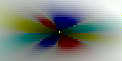
As expected the diagrams highlight the areas of maximal IF change, about the areas of greatest modulation depth, showing as red and blue 'rosettes' of colour. The reason behind the shape and colour of the rosettes can be explained using the graph shown in Figure 1. As can be seen, the slope of the IF peak is greatest the nearer the filter is to the area of maximal AM depth, with the IF peaks reducing in height and broadening as the filter moves away from this area. Therefore, since the filter peak becomes higher and narrower as we move towards the frequency of maximal AM the area showing red (positive change in IF between adjancent channels) will also become narrower. This results in a 'arrow' pointing towards the area of maximal AM, as seen in the rosettes.
Looking at the new representation diagrams we see that the 'rosettes' representing the areas of maximal AM seem relatively stable under noise. With a S/N ratio of 1 the rosettes are still clear and distinct, their time/frequency position remaining stable. However, a few new rosettes have appeared on the edges of the signal showing new areas of AM due to interference with noise. When the S/N ratio is reduced to 0.5 the rosettes due to signal AM are no longer distinct from those caused by noise interference, however, where they still exist their time/frequency position still seems unchanged. This would seem to indicate that whilst there is degradation under noise, tracking the positions of the AM rosettes could provide useful cues on AM period/frequency with relative accuracy.
 Extracting the point of Maximal AM
 Taking the ideas shown in the last section further, in order to aid the extraction of the point of maximal AM depth it would be more benificial to change the colour representation used above to one where the colour boundaries form a cross at this point.
As has been seen in the previous sections, there are three specific criterion for IF changes thatare specific to AM, (1) a peak/trough in IF across time, (2) a movement in this peak/trough across the filter CF in adjacent channels, and (3) a peak/trough in IF across channels.
We can see where these features occur in the spectrogram by using additional colours to represent all the possible conditions for IF changes due to AM. Therefore a new representation has been designed using the following colours:
This should split up the rosette seen before into 8 sectors instead of the 4 used in the previous images, forming a more detailed image about the point of maximal AM depth showing exactly what IF changes are taking place. Additionally, the new rosette should form a crosshair of colour boundaries across time, frequency, and time/frequency. This allows the point of maximal AM to be located with considerable accuracy by following colour boundaries until all three cross. Examples of this representation can be seen in Figures 6-9 below, showing the new representation of Figure's 2-5 above (50Hz/division, 5ms/division, starting at 200Hz):


As can be seen, the images show the rosettes in the same numbers and locations as in the previous representation although the rosettes are far clearer on Figure's 8 and 9 than on 4 and 5. However, it is the extra layer of detail available as to the IF changes within the rosette that is more interesting. For instance, the horizontal boundary between cyan/yellow segments of the rosette shows us the frequency of the point of maximal AM. This is because as the filter CF crosses this frequency the polarity of the IF deviation changes. In turn, this means that the IF slope over time is in a different direction above and below the maximal AM frequency, therefore we get a colour change across this frequency.
As well as allowing IF changes to be examined in greater detail, this representation also allows the identification of the the IF changes set out in the criterion for the point of maximal AM. An example where the individual criterion occur can be seen in Figure , where (1) is represented by blue, (2) by green, and (3) as red. The points where all three are present is shown as yellow (50Hz/division, 5ms/division, 100hz-1100Hz).


By way of an example this technique has been applied to a sample of a female speaker saying the word 'the' showing the areas of IF change, with the points of maximal AM depth marked with crosses(100-1000hz, 100Hz/50ms grid):

As expected, the points of maximal AM depth occur regularly spaced at the mid-point between formants, the point spacing was also found to correspond to the pitch of the speakers voice. This points to a number of areas where AM analysis could be of use, formant tracking, pitch estimation etc. The next section ' Pitch Detection using AM Analysis Techniques ' descibes the use of these techniques in estimating pitch.
|
